Showing posts with label honey. Show all posts

Wednesday, January 09, 2008

did I mention the ice cream maker?

I got one for Christmas from Emi & Kevin. A bright red one with not one but TWO mixing bowls (which I am told made the sales lady at the kitchen shop green with envy). For those of you who know me, then you know: this just might revolutionize my life.

For those of you who don't know me that well, would you believe I used to work on a dairy farm and make ice cream for a living? Well, it was just a summer job after college, and it wasn't just ice cream, but it was WORK. I was living with Em & Kev down in Simsbury, Connecticut. We were all working and living at Town Farm Dairy—a small jersey farm where we bottled the milk in glass bottles and shipped it off with the milk man to be delivered to the neighborhood families before sunrise.

After we bottled the milk, there'd still be tons of it remaining in the holding tank. So we'd make yogurt, cheese, cottage cheese, butter, cream fraiche—anything dairy to use up the leftover golden cream. (It really was golden too—those jersey gals make the best milk around, especially when they're eating all that fresh green grass in the summer months.)

On special occasions, we would make ice cream. The flavor would depend on what was growing in the garden patch (Rhubarb in spring, Strawberries in June) or on the fruit tree (Peaches in August). And in between we'd make chocolate, mint chip, and coffee chip. Making ice cream in large batches requires cracking A LOT of eggs and cutting up A LOT of strawberries. Then when the ice cream was finished churning, we would package it all by hand and race it one by one into the freezer. There was just Agnes and me, and when it was hot, we'd have to work FAST. Customers came from far and wide to get their hands on our limited edition flavors. Our cows produced a slightly higher fat milk, making the ice cream that much creamier, dense and smooth.

I learned a few things about ice cream making that summer. Then in the fall, I moved to Provence, France and learned even more. In France, it was less about the production and more about experimenting with flavor. We made a lavender vanilla ice cream that was out of this world. We also made some pretty unusual sorbets like ripe peach with lavender honey.

Ever since, I've been dying for the machine. You can always make it without the machine of course, with patience and a fork. But the machine makes you legit.

It's winter, so the first recipe I tried was this Cranberry Ice Cream (no milk at all mind you, just cream—a heart-attack waiting to happen). I wanted to follow the recipe to a T, but couldn't bear the thought of cranberry dessert without any kind of orange, or the idea of homemade ice cream without chocolate chips. So instead of cinnamon, I added Grand Marnier. And at the end I tossed in some chopped up dark chocolate bits. It came out pretty well for a first try.

Now I just gotta get my hands on David Lebowitz's ice cream book, The Perfect Scoop. That outta keep me busy.

Monday, May 07, 2007

bees for life

There’s been much ado about bees lately. They’re not doing so well. Colonies in their entirety have been disappearing. An article in the New York Times a couple weeks ago (Bees Vanish; Scientists Race for Reasons) describes a scenario called "colony collapse disorder" in which bees become disoriented and are unable to find their way back home. Historically, this is not the first time we’ve seen this type of behavior, but it’s the first time it’s reached such a massive scale, and on a global level too.

I’m sad for the bees. Can you imagine getting lost on your way home from the grocery store and never finding your way back -- your family waiting for their dinner, but never getting it?

But it’s not just the bees that are affected. We all love their Zen-like presence in the summer months. And I can’t imagine living without my Vermont honey. But these are mild, aesthetic pleasures. No, the big problem with bees disappearing is that human life as we know it could not exist without them. That’s because the majority of our crops rely on bees for pollination. No bees, no food for us. They’re miracle life workers, those bees!

So why are they disappearing?

Sophie, my beekeeper friend in Provence, once told me that pesticides are the cause, that it’s the chemicals that are causing the bees to lose their orientation. The Times articles states many theories -- viruses, mites, disease, pesticides, stress, poor diet -- but scientists don’t know for sure and are hesitant to single out just one cause at this point. It could be a combination of many factors.

The Department of Agriculture has concluded that we rely too heavily on bees as a primary pollinator. I can just imagine that in the near future, we’ll have found new methods of pollination (robots?). Bees won’t be in the picture any more. But that doesn’t mean we can forget about them or lose sight of their value in our world.

The term “beekeeper” should not be taken lightly. Yet, a good number of the possible reasons for the bees’ current demise are directly related to human interference. Is there a way that we as consumers can make a difference this late in the game? I’m not so sure. Awareness is a start. Maybe we could try only buying local, organic food and avoid supporting large-scale farms and crops that require mass transportation of bee hives for pollination. Maybe we could all use a little less honey.

What’s apparent to me is that bees rely on humans just as much as we rely on them. We need to give back a little of what we take -- food, serenity, life.

For now, I’m sending out some good vibes. I hope our bee friends find their way home.

Saturday, April 28, 2007

honey story

“Where do the honey bees go when they aren’t at the Winpenny’s?” I remember asking my mother long ago, in another lifetime.

The Winpennys were friends of ours who lived a hillside away from us where we grew up. We did everything together. The Winpennys had a sugarhouse they converted into a little cabin. And behind the sugarhouse, Ned Winpenny kept his beehives, abuzz with the sweet energy of life, the honey scent of a Vermont summer. When I think about it, the bees were a fitting extension of Ned’s own energy and life. He was a tall, vivacious fellow, with a moustache and hair the color of chestnut honey. He had a thick rusty moustache that would catch a layer of foam whenever he drank beer from a glass. It made me laugh. Ned and Patty Winpenny made a fantastic match. They both loved the outdoors and Vermont and were totally devoted to their family.

“Up to the pasture,” my mother replied with an airy grin, “Isn’t it heavenly?” We looked out to the large field that sloped up in wild blossom from the stoop of the sugarhouse. “It could just as easily be Austria,” she sighed. I was in as much awe as my mother, but as a four-year-old growing up in Pawlet, the beauty of Vermont’s landscape was really all I knew.

We lived in the Winpenny’s sugarhouse for the whole summer of 1984, while our house was being rebuilt after the fire. There wasn’t a door to the bathtub, and the toilet was a rotting outhouse beside the wood stack. But we didn’t care, my two sisters and I. It was a great adventure. We climbed on the old red tractor by the shed, and chased the geese. We watched as Tristan Winpenny, the oldest Winpenny boy nailed worms and slugs to a scrap of wood. The delight he showed as they squirmed in the sun was too much to resist for my sister Emma, and so she helped him.

One day my parents were away, so Patty took us swimming at Lake St. Catherine. We stayed there all day. The tepid water did little to cool us off. We were playing alligators and I started to feel a little queasy in my stomach. Patty was calling to us from the side of the road. It was time to go. As I was wading lazily to the edge, I felt something squishy in my swimsuit and realized what I had done. I was so scared that others would make fun of me; I wrapped my towel around my waist to hide it.

When we got into Patty’s rusted, silver VW van, I sat down and felt a cold oozing feeling between my thighs. I was terrified but had no choice except to sit there and wait until we got back.

With a great deal of embarrassment, I finally had to tell Patty what happened. I’ll never forget how kind she was and how much better she made me feel. She was so understanding, and together, we washed my clothes. I took a nice bath, and the whole ordeal was taken care of without any of the other kids knowing about it.

When we finally moved out of the sugarhouse a few months later, our adventurous summer quickly ended. It wasn’t long before we moved out of Pawlet completely and left that thrilling existence for good. It was sad to know that the Winpennys lived on without us there. Patty and Ned had a third boy. They even bought a new car. We saw them once a year in the summer for a visit--then even less frequently. But whenever we made it back, I would take a walk in the pasture, go inside the sugarhouse to stir up old memories, and visit the honeybees.

A few years later, we learned that Ned Winpenny had died. I was in high school then. He was still so young. Nobody expected it--least of all Patty.

Ned died in late August--one of the prettiest times of year in Vermont, when all's abloom and at its peak. We went to the funeral, which took place on their property right by the old sugarhouse. Friends and family blended together in a procession to the middle of the pasture. There in the midst of the heather and milkweeds lay a coffin that the boys had made by hand. I knew that Ned lay inside of the wooden box, but I didn’t believe it, so I didn’t cry.

I looked at the people around me. Raspberry eyelids. I didn’t know any of them, and my parents only recognized a few. I had grown away from this world that I loved so much.

Patty wasn’t at the procession. Nobody knew where she was. Finally she came down the pasture with long grasses and heather in her arms. She was laughing hysterically.

“Ned’s still here! He’s all around us!” She rejoiced. “Let’s dance, have a bonfire!”

I didn’t know what to believe or what to feel. I looked over at the sugarhouse. It was full of old junk. The honeybees were gone. The blooming pasture seemed to not even notice. We didn’t stay for the bonfire. We left soon after; knowing that this world we loved was gone from us.

I’ve seen Patty one time since the funeral. It was few years later when I was in college and we were down in Pawlet for Christmas. She had changed. She was not the same Patty who washed my swimsuit in secrecy. She was talking about eating bananas for breakfast. Still it was nice to catch up and be back in that big old house on the hill.

When we said goodbye that night, I grabbed her tightly and didn’t let go. I was a few inches taller than she was, and so I rested my cheek on her ear. She became still for a moment and pulled herself away. “Come back soon, ok?” We agreed and started for the door.

“Wait!” she yelled from the hall, and rushed towards us with a big jar of honey. “Here! It’s not the fancy kind, but it’s the last of what’s left over.”

“Thanks, Patty,” I whispered and squeezed the jar to my chest, “it’s the best honey in the world.”

Monday, August 07, 2006

wild honey

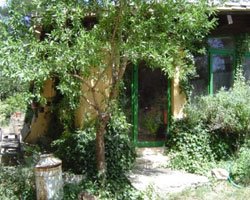
Sophie's houseAbout this time one year ago, while on a visit to my beloved Provence, I trekked into the Alpilles countryside to visit my bee-keeper friend, Sophie Berton. We feasted on honeyed delights: pork glazed with rich and potent chestnut honey, plum tarte with delicate lavender honey, beets and oranges flavored with tilleul honey (that of the lime tree blossom), and we tasted countless others collected from all the wild flowers and herbs of provence. It's a sacred thing, honey, with as many varietals as regions in the world, with as many distinct flavors and hues as the blossoms that inspire them.

Honey is also believed to have healing and nutrional values not only for the bee, but for humans as well. It's said to have been found--well-preserved--in Egyptian tombs dating back thousands of years. But what's most fascinating about honey is its power to evoke a piece of nostalgia in all of us.

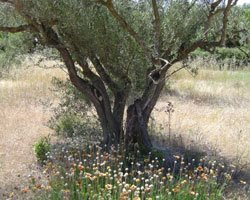
olive tree and Provence flowersIt's much more than a sweetener to me; it conjurs memories of wild clover, Vermont summer meadows, and long-lost friends; it reminds me of Heath apple orchard just north of the Canadian border where we'd suck the sweet nectar right from the honeycomb and then chew on the beeswax to savor every last drop. Slowly drizzling honey on a pot of fresh yogurt takes me away to southern France, where on one lovely summer day, I lunched on honey, goat cheese, mint, olives, and rosé in an ancient Roman ruins not far from Sophie's home.

These memories and more wafted out of my honey jar last night, and so I say, if you want to savor a moment forever, sweeten it first with wild honey.

LinkWithin - 4 posts

Related Posts Plugin for WordPress, Blogger...